
Smile makeover in Turkey: try it first, then decide.
A smile makeover is a cosmetic dentistry approach that combines several treatments in a single plan to bring the colour, shape and alignment of the teeth and the gum line into harmony with the face. In this guide to a smile makeover in Turkey, we explain how the plan is built digitally, what a mock-up trial is for, which treatment is chosen when, and where the limits lie.
- A smile makeover is not a single procedure but a plan; teeth whitening, veneers, zirconia crowns, gum contouring and, where needed, implants can all be parts of the same plan.
- Digital smile design (DSD) uses photos, video and an intraoral scan; the image on screen is not a promise but a draft to discuss.
- A mock-up is a trial of the designed teeth in your mouth using temporary material; it is the only way to see the result before any teeth are cut.
- Veneers and crowns require enamel to be removed, and this cannot be undone; with proper care, porcelain veneers usually last 10–15 years.
- If there is tooth decay or gum disease, it is treated first; a smile makeover is built on a healthy mouth.
- For patients travelling from abroad, a smile makeover is usually completed in a single 5–7-day trip; if implants are needed, the plan is split into two trips.
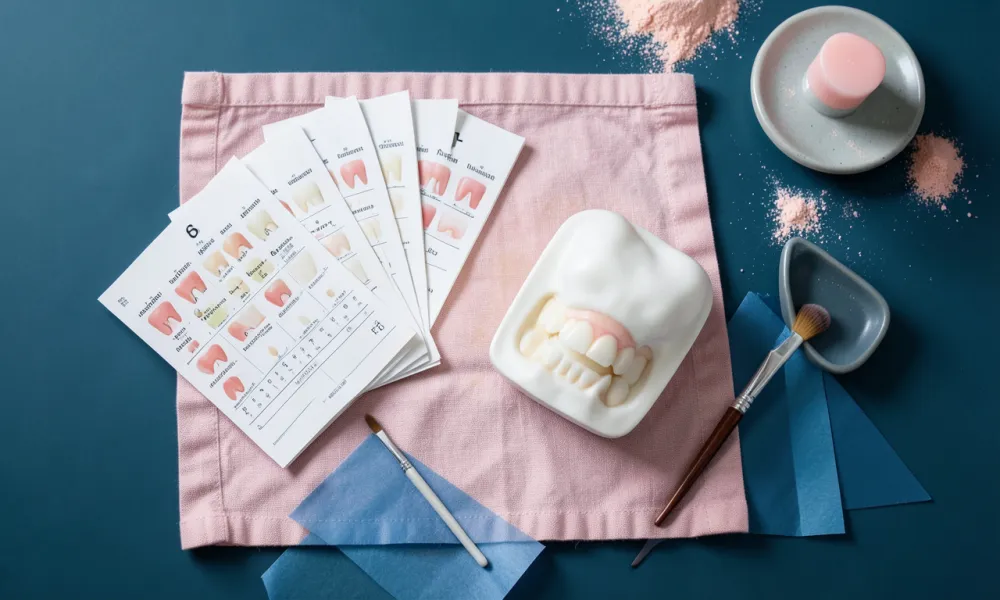
What is a smile makeover?
A smile makeover is a treatment approach that looks at the teeth and gums visible when you smile as a whole rather than one by one, planning the intended look in advance and then carrying it out. It is not the name of a single procedure; it is the plan that sets the order and scope of several treatments chosen according to need.
Cleveland Clinic defines cosmetic dentistry as the branch of dentistry focused on improving the appearance of your smile. A smile makeover brings the tools of this field together:
- Colour: stains, yellowing, differences in shade between teeth
- Shape: chipped, worn, short or disproportionate teeth
- Alignment: gaps, mild crowding
- Gums: gums that show too much when you smile or sit at uneven levels
On our dental treatments page we briefly introduce these treatments. Here we focus on how a smile makeover plan is put together and which decisions are yours to make.
Who is a smile makeover right for?
Adults whose oral health is generally good but who hold back when smiling because of the colour, shape or alignment of their teeth are suitable candidates for a smile makeover. What matters is whether the concern involves a single tooth or the smile as a whole; one stained tooth does not need a comprehensive plan.
In some cases cosmetic work has to wait. The American Dental Association's patient website explains in its information on veneers that tooth decay and gum disease must be treated first, and that veneers may not be a good choice for people who clench their teeth or have a deep bite.
- Treatment needed first: active decay, gum inflammation, infection at the root tip
- The plan changes: clenching and grinding, deep bite, severe crowding
Cutting teeth down and covering them to make them look ‘straight’ is quick, but it means giving up sound enamel. If the alignment problem is significant, orthodontics – braces or clear aligners – comes first in the smile makeover plan, and that does not fit into a single trip.
What does the dentist look at in a smile makeover?
The dentist looks at the face first, then the lips, and only then the teeth. A good smile makeover does not apply a ready-made template to the mouth; it measures the facial midline, lip movement and the proportions of the existing teeth, and draws the design around them.
- Midline: how the line where the two front teeth meet relates to the centre of the face
- Smile line: whether the biting edges of the upper teeth follow the curve of the lower lip
- Tooth proportions: the length-to-width ratio of the front teeth
- Gum display: how much gum shows when you smile and how symmetrical the gum levels are
- Colour and translucency: a shade that suits your skin tone, the whites of your eyes and your age
- Speech and bite: how the teeth meet the lips and the balance of chewing
The last point is often forgotten. A smile makeover that looks good in photos but upsets the bite comes back as fractures and sensitivity.
How is digital smile design done?
Digital smile design (DSD) means drawing the shape of the new teeth on a computer using facial photos, a short video of you talking and an intraoral scan. The aim is for the dentist, the laboratory and the patient to discuss the same image.
- Front and side photos at rest, with a slight smile and with a full smile
- A short video showing how your lips move when you speak
- A 3D model of the teeth taken with an intraoral scanner or an impression
For a remote preliminary assessment, an initial sketch can be prepared from the photos you send. The final design, however, is made at the examination after scans and X-rays, because a photo does not show the root beneath the tooth, decay or gum pockets.
A computer image cannot exactly reproduce light, the lip muscles or the way the gums heal. See the digital design as a way of explaining what you expect; the real test is the trial in your mouth.
What is a mock-up trial in a smile makeover?
A mock-up is the designed teeth applied over your own teeth in a temporary material, without any tooth being cut. It is the last reversible step in the smile makeover process: if you do not like it, it is removed and the design is changed.
A mould of the model produced from the digital design is filled with temporary material and seated over your teeth; in the mirror you see the new length, width and relationship with your lips. During the trial, check:
- Does the length of the teeth bother you when you speak?
- When you smile, do the teeth fill the lips or stick out too far?
- Is the shape too square or too rounded for your face?
- How does it look in photos and on video?
A mock-up does not show the colour exactly, and because it is added on top of the teeth it looks slightly bulkier than the final result. Teeth that sit forward and need reducing cannot be trialled with an additive mock-up; the dentist should tell you this from the start.
Which treatments does a smile makeover include?
The current condition of each tooth decides which treatment goes into the smile makeover plan: a sound tooth that is simply dark and a broken tooth with a large filling do not receive the same treatment. In a good plan, the option that achieves the result with the least intervention comes first.
| Treatment | What it corrects | Work on the tooth | Expected lifespan |
|---|---|---|---|
| Teeth whitening | Colour of natural teeth | None | Six months to three years |
| Composite bonding | Small chips, gaps, shape | Very little or none | About 5–8 years |
| Porcelain veneers | Colour, shape, mild misalignment | A thin layer of enamel is removed from the front | Usually 10–15 years |
| Zirconium crowns | Heavily filled, broken or root-canal-treated tooth | The tooth is reduced on all sides | 5–15 years on average, longer with good care |
| Gum contouring | Excess or uneven gum showing | Surgical reshaping of the gum | Considered permanent |
| Implant | Missing tooth | Surgical placement in the bone | Crown around 15 years on average |
These durations are the ranges given on Cleveland Clinic pages; care and bite force can change them. The difference between veneers and crowns lies in the surface they cover: a veneer covers only the front surface, while a crown wraps around the whole tooth. Where a tooth is missing, the plan follows the two-trip timeline described in our dental implant guide for implant cases.
Are healthy teeth cut down for a smile makeover?
It depends on the treatment chosen: whitening and bonding do not touch the tooth or touch it very little, veneers need a thin layer of enamel removed from the front, and crowns reduce the tooth on all sides. This is the question to ask most openly when discussing a smile makeover, because enamel that is removed does not grow back.
- Sound teeth that are only dark in colour are tried with whitening first
- For shape and small gaps, bonding or veneers may be enough
- Crowns make sense on teeth that already have a large filling, a fracture or root canal treatment
- Even with so-called ‘minimal-prep’ veneers, some enamel is removed
A plan that offers the same treatment for every tooth – the result often called ‘Turkey teeth’ – is easy to produce but is often more than is needed. Ask tooth by tooth why each treatment has been chosen; a tooth cut today loses a little more structure with every future replacement.
How does smile makeover treatment progress?
- Initial consultation with photos and X-rays. Your smiling photos and any panoramic X-ray are reviewed, and a first opinion is shared on possible treatments and the number of visits.
- Examination and records. On arrival in Turkey, X-rays, an intraoral scan and photos are taken, and tooth decay and gum health are assessed. We describe the overall flow of the trip on our treatment process page.
- Digital design and mock-up. The smile makeover is discussed on screen and then tried in your mouth; you can ask for changes before you approve it.
- Preliminary treatments. If needed, scaling, fillings, root canal treatment, teeth whitening or gum contouring are done at this stage.
- Preparation and temporaries. The teeth receiving veneers or crowns are prepared, impressions are taken, and temporaries in the approved shape are fitted.
- Try-in and bonding. The restorations from the laboratory are tried in; once you approve them, they are permanently bonded.
- Check-up and follow-up. Your bite is checked again before you leave. Ongoing care continues with your own dentist.
What does a smile makeover visit look like?
A smile makeover based mainly on veneers and crowns usually fits into a single 5–7-day visit; most of that time is spent waiting for the laboratory to make the restorations. The number of teeth and any need for preliminary treatment change the order and the length of stay.
| Stage | What happens at the clinic | What is expected of you |
|---|---|---|
| Arrival and examination | X-rays, scan, photos, digital design | Explaining what you expect, with examples |
| Trial day | Mock-up, design approval, shade selection | Looking in the mirror in daylight, not rushing |
| Preparation session | Tooth preparation, impressions, temporaries | Avoiding hard and sticky food with temporaries |
| Laboratory period | Making the restorations | Resting; noting anything about the shape of the temporaries |
| Interim try-in | Testing shape, colour and bite | Asking for any adjustment before bonding |
| Final session | Permanent bonding, bite adjustment | Collecting your aftercare instructions and records |
If gum contouring was part of the smile makeover, the tissue needs time to settle; the dentist decides, based on healing, whether the final restorations are made during the same visit.
How is a smile makeover in Turkey planned?
For patients travelling from abroad, a smile makeover is planned over one or two visits depending on its scope. Three things decide whether one visit is enough: whether implants are needed, the extent of any gum surgery and the need for orthodontics.
- Bonding is scheduled at least one day before your flight home; the bite is adjusted before you leave the country
- The shade is chosen in daylight; a shade chosen at an evening appointment is confirmed the next morning
- You are given your X-rays, scan files, material name and shade code; this makes future repairs easier
- Accommodation and transfers are arranged close to the clinic
Neda Deniz holds the Turkish Ministry of Health International Health Tourism Authorisation Certificate (AK-1032) and is an intermediary agency, not a clinic. All treatments within a smile makeover are carried out by our partner specialist surgeons in the relevant clinics. The doctor we work with in dental treatments is Oral, Dental and Maxillofacial Surgery Specialist Dr. Taylan Akça, and the doctor you proceed with is confirmed after the preliminary assessment. When choosing a dentist, check whether they offer a mock-up and give a reason for each tooth.
Smile makeover cost: what determines the price?
Turkish regulations do not allow price advertising for healthcare services, and because a smile makeover is a combination of treatments that varies from person to person, a single figure means little. On the NHS, dental treatment done purely for appearance, such as veneers or whitening, is generally not covered, so check with your dentist or insurer what, if anything, applies to you. When comparing quotes, it is enough to look at these items:
- Number of teeth and type of treatment: how many teeth get veneers, how many get crowns and which get whitening only
- Materials and laboratory: the type of ceramic, and whether it is made by hand or digitally
- Preparatory treatment: fillings, root canal treatment, gum treatment, gum contouring
- Planning: digital design, mock-up and temporaries
- Accommodation, transfers and number of visits
Most of the difference between two quotes usually comes not from the unit price but from the number of teeth to be cut. A smile makeover that involves fewer teeth can be both more economical and more conservative.
What are the limits and side effects of a smile makeover?
A smile makeover can change your appearance noticeably, but it is not a permanent, maintenance-free solution; restorations have a lifespan and some of the work cannot be undone. Before deciding, you should know these limits:
- Irreversibility: enamel removed for veneers and crowns does not come back
- Sensitivity: there may be sensitivity to hot and cold after preparation; it usually eases within weeks
- Fracture and debonding: porcelain can crack or come loose when biting on hard objects or through clenching
- Colour is fixed: porcelain and zirconia cannot be whitened later; the shade must be chosen correctly from the start
- Gum reaction: redness and recession around restorations with poorly fitting margins
- Decay risk remains: decay can form at the edge of and beneath a restoration
Let us also be clear about expectations: a smile makeover does not produce a copy of a smile from a photo; it is shaped around your face and teeth.
Our other treatment guides
If your smile makeover plan also involves a missing tooth or another procedure on the face, these guides can help:
- Dental implant guide — bone, grafting and the two-trip plan
- Rhinoplasty guide — open and closed technique
- Facelift guide — four techniques and recovery
- Hair transplant guide — choosing a method and planning the grafts
Making your decision
A smile makeover decision is made not by the number of teeth but by three questions: Is what really bothers me the colour, the shape or the alignment? How much of my sound teeth am I willing to give up for it? Will I give my approval without seeing the result in my mouth? The answer to the third question should be no.
If you are unsure about a smile makeover, getting an assessment first does not commit you to anything. Send us photos of your smile and any X-rays you have; our partner doctors will review them, and we will explain clearly which treatment is recommended for which tooth, and why. If whitening alone is enough, we will tell you that too.
Frequently asked questions about smile makeovers
How many teeth does a smile makeover involve?
There is no fixed number. The number of teeth visible when you smile varies from person to person; for some patients the front teeth are enough, for others the premolars are included in the plan too.
Is a smile makeover permanent?
No, it does not last a lifetime. With proper care, porcelain veneers usually last 10–15 years, and whitening keeps its effect for six months to three years. When that time is up, the restorations need replacing.
Do teeth have to be cut down for a smile makeover?
No. Whitening can treat colour problems and bonding can fix small shape flaws without cutting the tooth. Veneers need a thin layer of enamel removed and crowns need more reduction; the choice depends on the condition of each tooth.
What happens if I don't like my smile makeover mock-up?
The temporary material is removed and the design is reworked to your wishes. Nothing is lost at this stage because your teeth have not been cut. Permanent work should not begin until you have given your approval.
Does digital smile design show the exact result?
No; it gives a direction. The design on screen gives an idea of shape and proportion, but light, lip movement and gum healing affect the real result. The trial in your mouth is a more reliable preview.
How is the shade chosen in a smile makeover?
It is chosen with a shade guide, in daylight, and assessed alongside your skin tone. Because porcelain cannot be whitened later, the decision should not be rushed, and the chosen shade should be confirmed again the next day.
When is gum contouring added to a smile makeover?
It is added if too much gum shows when you smile or if the gum levels around the teeth are not symmetrical. Excess tissue is removed to reshape the gum line; the result is considered permanent.
Can I have a smile makeover if I clench or grind my teeth?
Yes, but the plan changes. Clenching can crack porcelain, so a stronger material, bite adjustment and a night guard come into consideration. Be sure to mention this habit at your first consultation.
How should I look after my teeth after a smile makeover?
Brush twice a day with a soft toothbrush, use floss, and do not bite through hard objects with your teeth. A check-up and clean at least once a year extends the life of your restorations.
If a veneer breaks after my smile makeover, can it be repaired in my home country?
In most cases, yes. A sound veneer that has come off can be re-bonded; a broken one is replaced. Keeping your records, including the material name and shade code, makes your own dentist's job easier.
We have received your request
Thank you. Our specialist team will contact you within one working day at the latest.
- 01Our consultant reviews your request and asks for anything that is missing.
- 02Partner doctors review your smile makeover file.
- 03Your personal smile makeover plan and total cost are shared with you.