
Hair transplant: not about getting back what you lost, but planning what is left.
A hair transplant is a surgical procedure in which follicles taken from the genetically resistant donor area at the back of the head are placed one by one into thinning areas. In this hair transplant Turkey guide we bring together the techniques, how the number of grafts is decided, the recovery timeline, what affects the price and how a hair transplant in Turkey is actually planned.
- A hair transplant does not create new hair; it moves shedding-resistant follicles from the back of the head into the thinning area. The donor area is therefore limited and has to last a lifetime.
- FUE and DHI are not two different operations but two ways of placing the follicles within the same procedure; the choice depends on the number of grafts, your hair type and the area being treated.
- More grafts does not automatically mean a better result; the size of the bald area and your donor capacity are calculated together.
- The transplanted hairs fall out in weeks 2 to 4 (shock loss). This is an expected stage, not a failure.
- Most of the result appears within 6 to 9 months and is complete at 12 to 18 months. A hair transplant is a process that requires patience.
- If hair loss is still active, a hair transplant on its own is not enough; without medical support the area behind the transplanted zone will open up again within a few years.
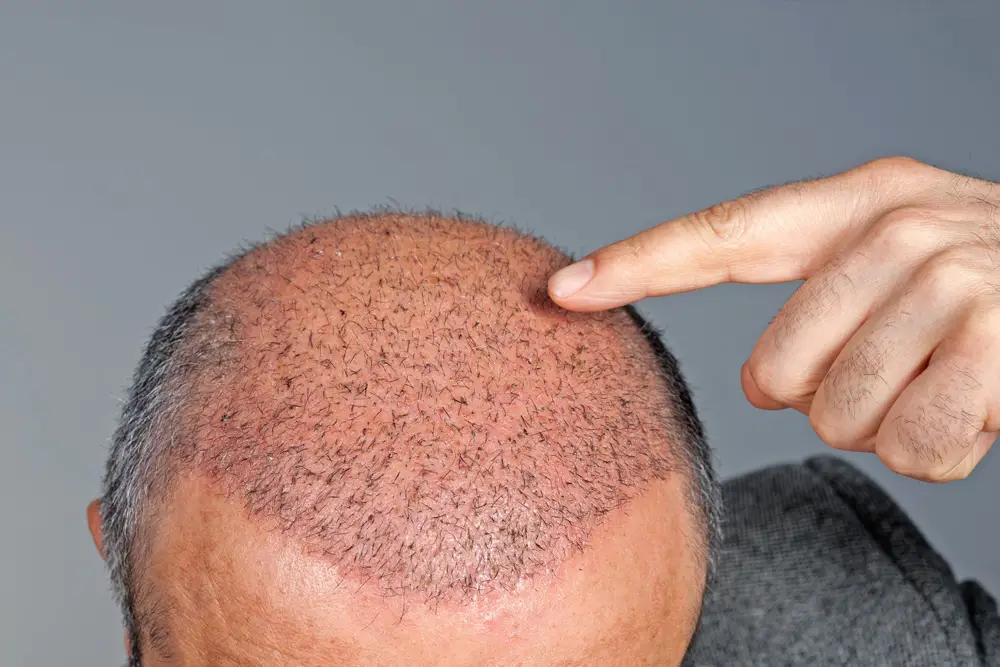
What is a hair transplant?
A hair transplant is the procedure of taking hair follicles from the area between the two ears at the back of the head and placing them one by one into thinning or completely bald areas. The follicles in this zone are genetically resistant to androgenetic hair loss and keep that property once moved. We summarised the scope of the procedure on our hair transplant treatment page outlines what the procedure covers; this guide takes the decision itself step by step.
There is a point that is often misunderstood here: a hair transplant does not produce hair, it redistributes it. Your total number of follicles does not increase. That is why a good hair transplant plan is less about covering the bald area and more about using the donor area in a way that lasts a lifetime.
- Brings a receded hairline forward again with a hair transplant
- Adds density to thinning at the crown (vertex)
- Reframes the temporal corners
- Covers gaps caused by scars, burns or previous surgery
Who is a hair transplant suitable for?
There is no single age limit for a hair transplant; what matters is that the hair loss has stabilised and that the donor area is sufficient. In general a hair transplant gives the most predictable result in people whose hair loss has slowed, whose donor area is dense and whose expectations are realistic.
- People with a receded hairline whose hair loss has stayed at the same point for several years
- People thinning at the crown but with a strong donor area
- People who have already had a hair transplant and want more density
- People with a localised gap caused by a scar or a burn
Rapidly advancing hair loss in your early twenties, a weak donor area, medical conditions that trigger shedding such as uncontrolled thyroid disease or iron deficiency, the use of blood thinners and the expectation of getting your teenage hairline back can all postpone a hair transplant. Only the doctor who examines you can make this assessment.
Hair transplant techniques in Turkey: FUE or DHI?
"Hair transplant" is not the name of a single operation but a family of techniques. Almost every method used today is based on FUE, in which follicles are extracted one by one; the difference lies mostly in how they are implanted.
| Technique | How it works | Best suited to | Key advantage |
|---|---|---|---|
| FUE (sapphire blade) | Channels are opened with a sapphire blade and the follicles are implanted in a separate stage | Large areas, high graft numbers | More grafts in a single session |
| DHI (Choi implanter) | Opening the channel and implanting happen in one movement | Implanting between existing hair, the front hairline | Low risk of damaging existing hair |
| Unshaven hair transplant | Only part of the donor area is trimmed | People who cannot take time off work, women | Leaves no visible shaved patch |
| FUT (strip method) | A strip of skin is removed from the back of the head and the follicles are separated under a microscope | Very high graft requirements, selected cases | Rarely chosen today, leaves a linear scar |
In practice these techniques are not rivals: in many patients the front hairline is done with DHI and the density behind it with FUE. Which hair transplant method is chosen is decided by your hair thickness, your graft requirement and the structure of the area, not by a marketing name.
How many grafts do you need?
A graft is a follicular unit that can contain one to four hairs. This is why "3,000 grafts" and "3,000 hairs" are not the same thing; 3,000 grafts correspond to roughly 6,000 to 7,500 hairs. When a hair transplant is planned, the square centimetres of the bald area and the load the donor area can carry are calculated together.
| Bald area | Approximate grafts | Typical hair transplant session |
|---|---|---|
| Temporal corners and hairline correction | 1,500–2,500 | Single session |
| Front zone + mid scalp | 2,500–3,500 | Single session |
| Front zone + crown together | 3,500–4,500 | Single session or two stages |
| Advanced hair loss | 4,500 and above | Usually two sessions |
Taking more follicles than the donor area can support leaves permanent thinning at the back of the head and removes the chance of a second hair transplant later. When you compare quotes, always ask how the grafts are counted.
How is a hair transplant performed?
A hair transplant is performed under local anaesthetic while you are awake and takes 6 to 8 hours depending on the number of grafts. The day usually runs in this order.
- Planning and drawing. The hairline is set according to facial proportions, the donor area is measured and the graft number is finalised. We describe the whole journey on our treatment process page.
- Preparation. The donor area is trimmed and local anaesthetic is applied.
- Graft extraction. The follicles are removed one by one with micro motor punches and held in a nourishing solution.
- Opening the channels. Angle, direction and density are decided at this stage — this is the step that really determines a natural look.
- Implantation. The follicles are placed one by one; single-hair grafts are used along the front hairline.
- Closing. The donor area is dressed and the first wash and aftercare are explained.
You feel no pain during surgery; patients describe a brief stinging while the anaesthetic is applied. Breaks are possible throughout and you can eat.
Hair transplant recovery timeline
With a hair transplant the result is seen over months, not on the operating table. Knowing the hair transplant recovery timeline in advance makes month three, the hardest part of the process, far easier to get through.
| Period | What happens | What to do |
|---|---|---|
| Days 1–3 | Swelling, crusting, tenderness in the donor area | Keep your head elevated; first wash under medical supervision |
| Day 4–10 | The crusts come away with washing | Daily washing, without rubbing |
| Weeks 2–4 | Shock loss: the transplanted hairs fall out | No need to panic — the follicles stay, the shaft regrows |
| Month 3–4 | It feels as though nothing is changing | Track the process with photographs |
| Month 6–9 | New hairs come through and density becomes visible | Follow-up examination |
| Month 12–18 | Thickening completes and the result settles | Final assessment |
It is an expected stage for the transplanted hairs to fall out between the second and fourth week after a hair transplant. What is shed is the shaft; the follicle stays in place and produces a new hair within a few months. Temporary thinning of existing hair can also occur in this period.
Is a hair transplant enough on its own?
For most patients, no. A hair transplant covers the bald area but does not stop hair loss; the hair outside the transplanted zone carries on following its own course. If someone with active hair loss has only a hair transplant, a new gap forms behind the transplanted area within a few years and the result looks patchy.
This is why a hair transplant is usually planned together with a treatment that slows hair loss. Only a doctor can decide which support is appropriate — and whether it should be used at all; ready-made protocols found online do not fit the individual.
Hair transplants in women
Hair loss in women does not usually progress as balding from the crown the way it does in men; it shows as diffuse thinning across the scalp. For that reason thyroid, iron and hormone levels must be checked before any decision about a hair transplant in women. In suitable cases an unshaven hair transplant is preferred, either to bring the hairline forward or to add density along the parting.
What determines hair transplant Turkey costs
The price of a hair transplant in Turkey cannot be reduced to a single item. The difference between two clinics in the same city usually comes down to who performs the surgery and how many patients are seen in a day.
- Number of grafts and length of the hair transplant session
- The technique used (FUE, DHI, unshaven hair transplant)
- Whether the doctor performs the procedure, and the experience of the team
- Hospital and operating theatre standards where the hair transplant is performed
- Accommodation, transfer and interpreting included
- Follow-up examinations and hair transplant aftercare
Extremely low prices are usually achieved by cutting something: graft numbers are inflated, the procedure is left entirely to technicians, or too many patients are booked in a day. A hair transplant is permanent; correcting a badly planned result costs more than the first operation. An exact figure is only shared after an examination and a personalised plan.
Hair transplant Turkey: why is it chosen?
Turkey has one of the highest hair transplant patient volumes in the world. The reason people choose a hair transplant in Turkey is not only price: it is the experience that comes with high case numbers, a health tourism system licensed by the Turkish Ministry of Health, and an established chain of accommodation, transfers and interpreting.
- A hub where doctors and teams experienced in hair transplants are concentrated
- Hospitals and intermediary agencies regulated by Ministry of Health licensing
- Meet and greet, transfer, accommodation and interpreting in a single programme
- A short hair transplant Turkey programme: three days is enough for most patients
Neda Deniz International Health Tourism is not a clinic but a licensed intermediary agency approved by the Ministry of Health (Licence No: AK-1032). During your hair transplant in Turkey we handle matching you with partner doctors and hospitals, planning the programme and following up afterwards. You can find the details on our accommodation and transport page.
The most common hair transplant mistakes
- A hairline that does not suit your age: a hairline designed for a twenty-year-old does not look natural at forty; it must be planned to work for a lifetime.
- Overharvesting the donor area: taking too many grafts today destroys the chance of a second hair transplant tomorrow.
- Errors in direction and angle: channels opened at the wrong angle leave an artificial look even when density is sufficient.
- Operating before hair loss has stabilised: a hair transplant done too early is left stranded like an island in the middle of advancing hair loss.
- Leaving it without follow-up: a result that is not reviewed until the end of the first year means correctable shortcomings are noticed too late.
Procedures considered in the same plan
A hair transplant in Turkey can be planned into the same trip as other procedures, as long as the recovery timelines do not clash.
- Rhinoplasty — the procedure most often combined with a hair transplant
- Facelift and neck lift — recovery takes longer, so medical approval is required
- Dental treatments — easily added to the same programme
- Liposuction and tummy tuck — body contouring
Making your decision
A hair transplant is decided not by comparing prices but by your donor capacity, where your hair loss has settled and a plan that also covers the next ten years. The right question is not "how many grafts will I get" but "what can my donor area support, and who is going to carry out this plan".
If you are not sure what to do, an examination commits you to nothing. Send us your photographs and your questions, let our partner doctors review them, and we will set out the realistic options openly. If we think a hair transplant is not right for you, we will say so plainly.
Frequently asked questions about hair transplant Turkey
Is a hair transplant permanent?
The transplanted follicles are taken from a donor area that is genetically resistant to shedding, so they stay permanently in their new position. However, a hair transplant does not stop your existing hair from thinning; this is why it is usually planned alongside medical treatment.
Is a hair transplant painful?
The hair transplant is carried out under local anaesthetic and you feel no pain during surgery. There is a brief stinging sensation while the anaesthetic is applied. Afterwards patients describe tightness and tenderness in the donor area rather than pain.
When will I see the results of my hair transplant?
The first growth starts in month 3 to 4, noticeable density appears at month 6 to 9, and the final result settles between months 12 and 18. A hair transplant is a process that requires patience.
Why did the transplanted hairs fall out?
The shock loss between weeks 2 and 4 is an expected stage. What falls out is the shaft; the follicle stays in place and produces a new hair. No additional treatment is needed at this point.
How many days do I need to stay in Turkey for a hair transplant?
A three-day hair transplant Turkey programme is usually enough: consultation and blood tests, the day of surgery, then the first wash and check-up the following day. The return flight is normally planned for the end of the third day.
Will I need a second session?
A second hair transplant may be planned for advanced hair loss or when you want to increase density. At least 10 to 12 months are left between sessions.
Does a hair transplant leave scars?
With FUE the follicles are extracted one by one, so no linear scar is left; tiny dot marks may be visible in the donor area when the hair is very short. FUT, by contrast, leaves a permanent linear scar at the back of the head.
When can I go back to work after a hair transplant?
Most people return to a desk job within 3 to 5 days. Heavy exertion, sport, swimming pools and saunas are resumed after 3 to 4 weeks with your doctor's approval.
Do smoking and alcohol affect the result?
Yes. Both impair blood supply to the tissue and reduce graft survival after a hair transplant. You are asked to stop at least one week before surgery and for the two weeks that follow.
Can women have a hair transplant?
Yes. However, because hair loss in women tends to present as diffuse thinning, thyroid, iron and hormone levels are checked first. Where suitable, an unshaven hair transplant is preferred.
What determines the price of a hair transplant?
The number of grafts, the technique used, the team performing the hair transplant, the hospital standards and the accommodation package all shape the price. An exact figure is only given after an examination and a personalised plan.
We have received your request
Thank you. Our specialist team will contact you within one working day at the latest.
- 01Our consultant reviews your request and asks for anything that is missing.
- 02Partner doctors review your hair transplant file.
- 03A hair transplant plan that suits you and the total cost are shared with you.