
Dental implants in Turkey: a plan that starts with the bone.
A dental implant is an artificial root, shaped like a screw, that is placed in the jawbone in place of a missing tooth's root and carries a crown, bridge or denture. In this guide we bring together how the bone is assessed, when a bone graft is needed, how long healing takes and how two trips to Turkey are planned for dental implants.
- An implant has three parts: the screw in the bone, the connector that links it to the tooth (abutment) and the crown you see in your mouth.
- Fusion with the bone, known as osseointegration, usually takes 3–6 months and in some patients up to 9 months.
- If there is not enough bone, a graft is done first; it takes at least 3 months to mature, and 9–12 months for large grafts.
- For patients travelling from abroad, dental implant treatment is split into two trips: surgery on the first, the permanent teeth on the second.
- Initial healing after surgery takes about a week; swelling and tenderness ease noticeably during this time.
- A well-cared-for implant can last for decades; the crown or bridge on top needs renewing after about 15 years on average.
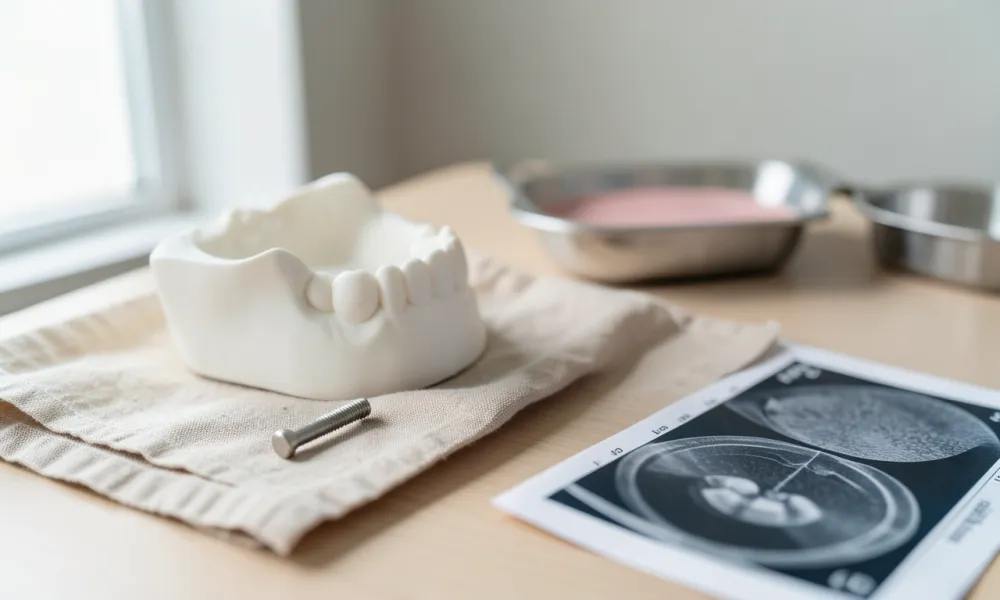
What is a dental implant and what parts does it have?
A dental implant is a small screw made of a biocompatible material that is surgically placed in the jawbone to mimic the root of a lost tooth. It is usually made of titanium. Over time the bone attaches to the surface of the screw and the implant becomes strong enough to carry a fixed tooth.
An implant is not a single piece but a three-layer system:
- Implant body: the screw that sits inside the bone and cannot be seen
- Abutment: the connector between the screw and the restoration
- Restoration: the crown, bridge or denture you see in your mouth
On our dental treatments page we summarised how implants compare with other options. This guide goes into the side that is talked about less: bone, grafting, waiting times and the timing of two trips.
Who is a good candidate for dental implants?
Adults whose jaw has finished growing, whose gums are healthy and who have enough bone to support an implant are good candidates. The lower age limit is generally taken as 18; there is no upper limit. What decides is not your age on paper but your general health and oral hygiene.
Cleveland Clinic's patient information on implants says that an implant should be postponed, and the underlying problem treated first, in the following situations:
- Untreated gum disease or widespread tooth decay
- Uncontrolled diabetes
- Conditions and certain medicines that affect bone metabolism
- Advanced jawbone loss (which a graft can overcome)
Tobacco and e-cigarettes slow wound healing and make it harder for the screw to attach to the bone. If you are planning implants, set your quit date before surgery. Mention blood thinners and osteoporosis medicines at the first consultation as well.
Do I have enough bone for a dental implant?
Whether there is enough bone is shown by imaging, not by an examination: a panoramic X-ray gives the first impression and a 3D CT scan confirms the decision. The surgeon looks at three things on these images: the height, width and density of the bone. An implant only lasts if it can be surrounded by bone on all sides.
Once a tooth is removed, the bone in that area slowly shrinks because it no longer carries any load. So the longer the gap has been there, the more likely it is that bone has been lost. The scan also measures these neighbouring structures:
- Upper back teeth: the distance between the floor of the sinus and the top of the bone
- Lower back teeth: the position of the nerve canal that supplies feeling to the lip and chin
- Front teeth: the thin bone wall and gum level, which determine the aesthetic result
For a remote preliminary assessment, a panoramic X-ray is usually enough; the CT scan is taken at the start of the first trip and the final plan is confirmed that day.
Dental implant bone graft and sinus lift: when are they needed?
If there is not enough bone to surround the implant on every side, it is first built up with a graft. A bone graft is a scaffold material placed in the deficient area, which the body gradually turns into its own bone. In the upper back teeth, if the bone is very close to the sinus, the sinus floor is raised and the space beneath it filled with graft; this is called a sinus lift.
Cleveland Clinic's bone graft page lists four sources of graft material:
- The patient's own bone
- Human bone from a licensed tissue bank
- Animal-derived bone
- Synthetic bone made in a laboratory
According to the same source, a graft takes at least three months to mature; for large grafts this can rise to 9–12 months. For small defects, the graft and the implant can be placed in the same session. For larger defects, the graft heals on its own first and the screw is placed in a separate session; this difference directly changes how many trips you need.
Single tooth, implant bridge or full arch: which plan is right?
How many implants you need is decided not by the number of missing teeth but by the load to be carried and how the bone is distributed. You do not need one screw for every missing tooth; a few implants can support a bridge spanning the gap or a whole-jaw prosthesis.
| Plan | How it is built | Best for | What to keep in mind |
|---|---|---|---|
| Single tooth | One implant, one crown | Healthy neighbouring teeth, one missing tooth | Neighbouring teeth are not cut down |
| Implant-supported bridge | Two or more implants, three or more teeth | Several missing teeth side by side | Cleaning under the bridge needs care |
| Fixed full arch | Usually four to six implants (All-on-4 / All-on-6), a full row of teeth | A toothless jaw or teeth that cannot be saved | Bone distribution and bite force are decisive |
The classic alternative for a single gap is to file down the two neighbouring teeth to anchor a bridge. An implant leaves those healthy teeth alone and, because it passes chewing forces to the bone, slows bone loss. On the other hand, it needs surgery and the timeline is measured in months. For crown materials, see our comparison of zirconia and veneers .
Dental implant procedure: what are the stages?
- Preliminary assessment with an X-ray. Your panoramic X-ray, intraoral photos and medical history are reviewed; you receive an initial view on the number of implants, the likelihood of a graft and the number of trips.
- Examination and 3D planning. On arrival in Turkey a CT scan is taken, the bone is measured and the position and angle of the implants are planned. We describe the overall flow of the trip on our treatment process page.
- Surgical placement. The area is numbed with local anaesthetic; sedation can be added on request. The gum is opened, a socket is prepared in the bone, the implant is placed and the gum is stitched.
- Healing period. You return home. Over these months the bone attaches to the surface of the screw; all that is asked of you is to keep the area clean and not put strain on it.
- Abutment and impressions. On the second trip the top of the implant is uncovered, the abutment is fitted and impressions are taken for the permanent tooth. This appointment usually takes about an hour.
- Permanent teeth and follow-up. After a try-in, the crown or bridge is fixed in place and your bite is checked. In the years that follow, check-ups continue with your own dentist.
Dental implant healing time: how long does fusion with the bone take?
Fusion, or osseointegration, takes 3–6 months in most patients and can extend to 9 months depending on bone quality and healing speed. During this time bone cells grow onto the rough surface of the screw and lock it in place; you do not feel anything from the outside.
| Period | What happens | What to do |
|---|---|---|
| First 24 hours | Numbness wears off; some soreness and light bleeding are possible | Cold compresses, lukewarm or cold soft food, no spitting |
| Week 1 | Initial healing is complete, discomfort eases | Check-up; stitches removed unless dissolvable |
| Weeks 2–8 | The gum closes and the bone begins to remodel | Soft toothbrush, no hard biting on the area |
| Months 3–6 | The implant attaches to the bone | Check-up X-ray, date of the second trip |
Because the upper jawbone is more porous than the lower, surgeons usually allow a longer waiting time in the upper jaw. The American Dental Association's patient website also describes treatment in three stages : placing the implant, the bone growing around it, and fitting the artificial tooth.
Will I be left without teeth while the implant heals?
No, in most cases you will not. Especially at the front, the surgeon prepares a temporary solution that fills the gap until fusion is complete. Which one is chosen depends on how firmly the implant sits in the bone on the day it is placed.
- Temporary removable denture: puts no load on the screw; the most cautious option
- Temporary tooth bonded to the neighbouring teeth: an aesthetic interim solution for a single gap
- Temporary crown on the implant: fitted the same day or within a few days if the screw is firm enough
A temporary tooth on the day of surgery is possible for some patients, but it is decided by how firmly the screw sits when it is placed, not by an advert. In patients who have had a graft or who grind their teeth, early loading puts fusion at risk. The tooth fitted that day is temporary; the permanent one is still made after fusion.
Dental implant aftercare: how do you look after implants?
In the first week the aim is to protect the blood clot and stitches; in the years that follow, it is to keep the gum around the implant healthy. An implant cannot decay, but the bone and gum that hold it can become inflamed, so cleaning is the key to a long life.
- On the first day, avoid hot food and drinks, straws and spitting
- Eat soft, lukewarm food for a few days and chew on the other side
- Until the stitches are out, clean the area gently with a soft brush without pressing
- Once the permanent tooth is fitted, use interdental brushes or a water flosser
- Have a check-up X-ray and a professional clean at least once a year
A loose implant, bleeding or swollen gums, fever and discharge from the area are signs you should report without waiting.
Dental implants in Turkey: how many trips, and how are they planned?
Dental implants are one of the few treatments that cannot be finished in a single trip: surgery is done on the first visit, there is a 3–6-month healing period in between, and the permanent teeth are fitted on the second visit. What sets the timetable is not the flight but how fast your bone heals.
- First trip: CT scan, extraction and grafting if needed, surgery. The stitch check is done before you leave the country.
- The months in between: you send a check-up X-ray taken in your own city; the second date is confirmed based on it.
- Second trip: impressions, try-in and fixing the permanent teeth; it takes a few days because of laboratory time.
- Flight: if you have had a sinus lift, have your return date approved by the surgeon.
Accommodation and transfers are planned separately for each trip. For patients whose graft is done in a separate session, the number of trips can rise to three.
Neda Deniz holds the Turkish Ministry of Health International Health Tourism Authorisation Certificate (AK-1032) and is an intermediary agency, not a clinic. Dental implant surgery and the prosthetic stage are carried out by our partner specialist surgeons in the relevant clinics. The doctor we work with in dental treatments is Oral, Dental and Maxillofacial Surgery Specialist Dr. Taylan Akça. Which doctor you proceed with becomes clear after the preliminary assessment. When choosing, ask who will do the surgery and who will make the crowns, which implant brand will be used and whether that brand has service support in your country.
Dental implant cost in Turkey: what determines the price?
Turkish regulations do not allow price advertising for healthcare services, and the cost of dental implants depends less on the number of screws than on what has to be done around them. On the NHS, implants are only offered in limited cases, which is why many people compare private options at home and abroad. When two quotes for the same number of implants differ, the difference usually comes from these items:
- Implant system: brand, surface technology and the manufacturer's documentation
- Bone procedures: graft, sinus lift, membrane material
- Restoration: crown material, single tooth or bridge
- Imaging and temporary teeth
- Accommodation and transfers for both trips
Which implant brand and model will be used, and will you receive an implant card with serial numbers? Are the graft and temporary teeth included in the price? Are the costs of the second trip calculated separately? If an implant does not fuse, what are the replacement terms?
What are the risks of dental implants?
In experienced hands the complication rate is low, but an implant is surgery and it is not risk-free. Some problems appear in the first weeks, others years later.
- Failure to fuse: the screw does not attach to the bone and has to be removed; smoking and uncontrolled diabetes raise the risk
- Infection: pain, swelling and discharge at the surgical site
- Nerve involvement: numbness of the lip and chin in the lower jaw; this is why a CT scan matters in planning
- Peri-implantitis: gum and bone loss around the implant caused by plaque build-up over the years
- Mechanical problems: a loose screw, a cracked or chipped crown
In Turkey, the professional framework for dentistry is set by the Turkish Dental Association . Let us be just as clear about expectations: a dental implant is not identical to a natural tooth, it needs looking after, and the crown on it will one day need replacing.
Our other treatment guides
If you are also considering another procedure on the same trip or later on, these guides take the same approach:
- Hair transplant guide — choosing a method and planning the grafts
- Rhinoplasty guide — open and closed technique
- Facelift guide — four techniques and recovery
- Breast reduction guide — scar types and breastfeeding
Making your decision
The decision about dental implants is not made by the screw brand but by three questions: Is my bone enough, or do I need a graft first? Can I plan the months in between and a second trip? Who will do my check-ups once I am home? If these three answers are clear, the rest is technical.
If you are not sure, getting an assessment first does not commit you to anything. Send us your panoramic X-ray and your questions; our partner doctors will review them and we will explain clearly how many trips you need and what steps lie ahead. If implants are not the right option for you, we will tell you that too.
Frequently asked questions about dental implants
Does getting a dental implant hurt?
Thanks to local anaesthetic, you should not feel pain during surgery; you may feel pressure and vibration. The soreness and swelling afterwards are usually controlled with painkillers and ease noticeably within about a week.
Can an implant be placed straight after a tooth extraction?
In some cases, yes. If there is no infection in the socket and the bone walls are intact, the implant can be placed in the same session. Where the socket is infected or bone has been lost, healing comes first, followed by a graft if needed.
Is there an age limit for dental implants?
The lower limit is the end of jaw growth, generally taken as 18. There is no upper age limit. Later in life, what matters is your general health, the medicines you take and the condition of the bone.
Can people with diabetes have dental implants?
Yes, if blood sugar is under control. Uncontrolled diabetes impairs wound healing and fusion with the bone, so the surgeon may want to see recent test results and postpone treatment if necessary.
Can you have implants if you are allergic to titanium?
A true titanium allergy is rare. If it is suspected, an allergy assessment is requested first. For suitable patients, metal-free zirconia implants may be an option; the decision is made together with the surgeon.
Do dental implants cause problems with MRI scans or airport security?
Titanium is not magnetic; implants generally do not prevent an MRI scan and rarely set off security gates. Even so, it is wise to tell the technician that you have implants before any imaging.
What happens if a dental implant fails?
An implant that has not fused is removed and the area is left to heal. In most patients it can be tried again a few months later, with a graft if needed. Ask for the replacement terms in writing before treatment begins.
Dental implant vs bridge: how do you choose?
If the neighbouring teeth are healthy, an implant closes the gap without cutting them down. If those teeth already need crowns, or you would rather avoid surgery, a bridge gives a result sooner. The condition of the bone decides.
How is the check-up between the two trips done?
Towards the end of the healing period you have a check-up X-ray taken where you live and send it to us. The surgeon reviews the image; if the bone is ready, the date of the second trip is set accordingly.
When does the crown on a dental implant need replacing?
Crowns and bridges last around 15 years on average; this depends on oral hygiene and bite force. If one breaks or loosens, only the crown or bridge is replaced and the implant stays in place.
We have received your request
Thank you. Our specialist team will contact you within one working day at the latest.
- 01Our consultant reviews your request and asks for anything that is missing.
- 02Partner doctors review your dental implant file.
- 03Your personal implant plan and total cost are shared with you.